

Aesthetics for dummies
METASKILLS Chapter 15

People use the word aesthetics to cover a wide range of concepts, many of them shallow, unhelpful, or wrong. Leonard Koren catalogs ten separate definitions in his little book, Which “Aesthetics” Do You Mean? Among them are “the superficial appearance of things,” as in “Charlie doesn’t give a damn about aesthetics—he just wants a car that runs”; “a style or sensibility,” as in “Objects scavenged from the Manhattan sewers were used to create the edgy aesthetic of Bob’s downtown loft”; and “a synomym for artistic,” as in “Lorraine applied her aesthetic imagination to come up with tonight’s dessert—lavender-infused grappa sponge cake with pan-seared guacamole frosting.”
Many creative people would just as soon throw the whole notion out the window. They’ll tell you that there are no universal rules for creating beauty, and that anyone who says there are can’t be a real artist. There’s some truth in this, because invention consists of generating new rules rather than following old ones. Maybe this is why painter Barnett Newman said, “Aesthetics is for the artist as ornithology is for the birds.”
But aesthetics is not a set of rules or a book of laws. It contains a collection of principles—perceptual tools—that every artist and inventor uses, whether consciously or unconsciously. My personal belief is, after trying it both ways, that a deliberate use of aesthetic tools is more effective than relying on “natural genius” alone. Once you understand the basic principles, you can use them to get unstuck, address new problems, or cross over into other disciplines. With practice they become absorbed by your unconscious mind, at which point they become intuitive.
My own definition of aesthetics is this: the study of sensory and emotive values for the purpose of appreciating and creating beauty. Aesthetic principles, also called formal qualities, are the tools we use to give form to the objects of design. These include concepts such as shape, line, rhythm, contrast, texture, and so forth, which can be employed in endless combinations. There are no hard and fast rules for using aesthetic tools. They only need to make the object “more of what it wants to be” instead of merely more. Using aesthetic tools just to use them is aimless—like using kitchen tools just because you find them in the drawer.
Some philosophers believe that objects impart aesthetic value through their formal qualities alone. Others disagree, saying the value of the object comes from its reference to other things. This difference of opinion sets up a false dichotomy. Is beauty timeless or temporary? Universal or personal? Skin deep or down to the bone?
The reason these questions plague us is that beauty can be any or all of these things, depending on the object itself (person, place, thing, experience, situation), the object’s embodiment (its formal qualities), and “the eye of the beholder” (one’s personal or cultural associations with it). Formal qualities and symbolic qualities are not necessarily opposites, but may simply exist on different planes.
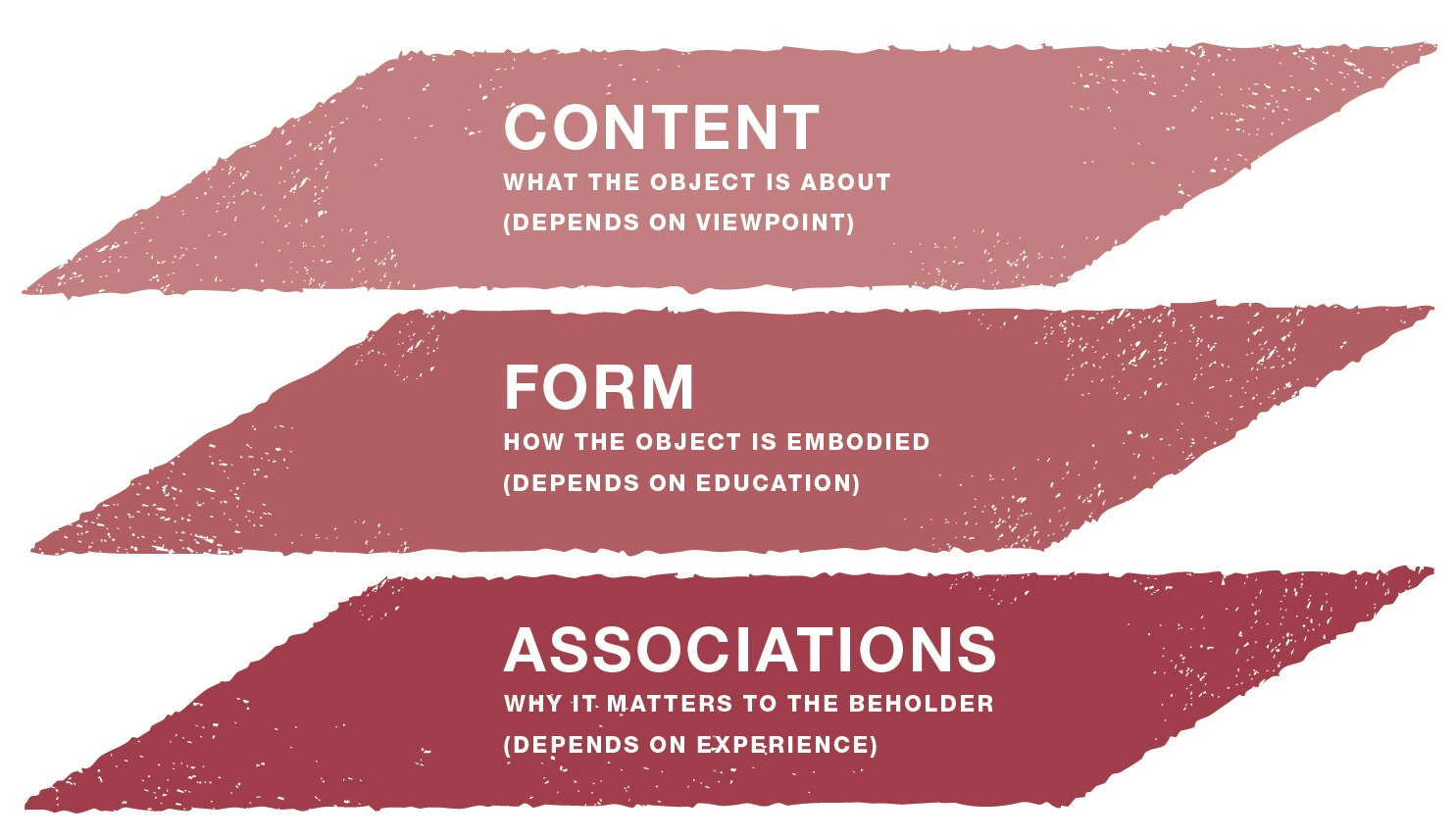
Imagine beauty as a birthday cake. (It could be a bicycle, a ballroom, or a balalaika, but let’s keep it simple.) In this example, the cake itself is the content, or the basic thing being experienced. We can appreciate content for its informational or functional value alone (as food), but there’s no real beauty without the other two planes of experience. The content supplies the “quiddity,” or “is-ness” of the object, yet by itself is rather neutral and emotionless.
Of course, the cake can’t exist without a specific form—or a set of formal qualities—to embody its content. In this case the formal qualities include six layers of sour cream chocolate cake with semisweet dark chocolate filling, a cylindrical shape, rum-flavored cream cheese frosting dripping down the sides, lime green script on the top, and thirty pink candles spaced evenly around the circumference.
Formal qualities are always determined by the type of object they embody. They might include shape, sound, color, pattern, balance, sequencing, a way of operating, or anything else, depending on the category. The formal qualities of music, for example, include melody, harmony, and rhythm while the formal qualities of painting include line, pattern, color, and scale. The formal qualities of a business model include products, pricing, sales, and distribution. Of course, these are just a few of the elements needed to give form to these things.
Formal qualities by themselves are fairly abstract. But married to content, they bring the object to life, giving it properties that awaken strong feelings. When content and form are well matched, the combination can seem iconic, a marriage made in heaven. And in some artistic endeavors, such as modern music or abstract expressionism, the form comes very close to being the content. With the example of the chocolate cake, we could stop with content and form and still end up with a good aesthetic experience. But there’s a third plane, the plane of personal associations.
Associations can include the memories, understandings, cultural norms, tribal allegiances, and personal aspirations we bring to our experiences. When we experience content and form through the lens of our associations, we create meaning. In fact, for most people, association is the most powerful determinant of beauty.
Beyond the sheer yumminess of the chocolate and rum-flavored cream cheese, the cake may remind you of happy birthdays from your childhood, giving you the warm glow that comes from feeling loved. Or it may impart a feeling of wistfulness, because it happens to be your birthday, and after thirty years of struggling you had hoped to achieve more with your life. These are the associations the cake is triggering—influencing the meanings you take from it and the reason it matters to you. For most people, it’s this plane of experience that’s easiest to appreciate and the most emotionally charged.
Does that mean we can dispense with formal beauty and just create things that people can connect with on a meaning level? Sure. We do it all the time. We produce cartloads of kitsch, floods of fashion, torrents of tribal identifiers such as logo products, lot-filling “luxury” homes, me-too tattoos, derivative genre music, and trendy personal electronics that help us fit into the groups of our choice. But the satisfaction we get from these objects is often shallow and fleeting, and eventually we wonder if there might be something more.
With a little effort and thoughtfulness, we can begin to appreciate beauty for its formal qualities, apart from its content and our personal associations with it. We can marvel at everyday things, like the asymmetrical placement of an upper story window, or the roughness of chipped paint on a child’s toy, or the sound of a delicate cymbal floating over a gruff bass line. We can take delight in the shape of certain phrases or the unresolved contrast of bitter and sweet or the negative space inside a lowercase a. We can find fascination in the symmetry of an equation, the poetry of battle, or the shrill cacophony of a grammar school playground.
At this point the realm of aesthetics opens up to us. We’re able to escape the narrow confines of personal meaning and embrace the beauty that’s hidden everywhere. We move out of the house and into the world. We start to demand more from the things we buy, the people we take up with, the experiences we give ourselves. Using aesthetics, we learn to separate the authentic from the fake, the pure from the polluted, the courageous from the timid. In short, we develop good taste.
Good taste is the promise and the payoff of aesthetics. And like beauty, good taste can’t be bought. It’s not a manual you can memorize, or an attitude you can adopt. It’s not a synonym for snobbishness, because snobbishness isn’t, well, in good taste. Good taste has long been considered a quality that existed mostly in the eye of the beholder. The Romans had a saying for it: “De gustibus non est disputandum,” or “About taste there’s no argument.” But this isn’t completely true. While there’s a wide range of what might be considered good taste, it doesn’t stretch on forever. There’s such a thing as bad taste, too, and most of us know it when we see it.
What the “birthday cake” model of aesthetics allows is the coexistence of personal associations (the eye of the beholder) with formal qualities (the eye of the educated beholder). The education of the eye and other senses is what separates those with good taste from those with ordinary or bad taste. This is not snobbishness. It’s a recognition that you have to work to develop good taste, and it’s mostly in the area of understanding formal principles.
The psychologist Howard Gardner writes about it in his book Truth, Beauty, and Goodness Reframed: “All young people will acquire and exhibit aesthetic preferences. But only those who are exposed to a range of works of art, who observe how these works of art are produced, who understand something about the artist behind the works, and who encounter thoughtful discussion of issues of craft and taste are likely to develop an aesthetic sense that goes beyond schlock or transcends what happens to be most popular among peers at the moment.” In other words, good taste is learned through conscious effort.
If we were to plot aesthetic learning on a continuum, we could label the left side of the scale “meaningless messes,” indicating ugly objects that exhibit no formal order and trigger no associations. We could label the right side of the scale “high aesthetics”, indicating beautiful objects with perfect order and the ability to trigger truly meaningful associations.
Without an educated sense of aesthetics, your appreciation of beauty is likely to fall nearer the left side, toward objects that are high in associative meaning, but low in formal excellence. This favors “tribal aesthetics,” or a preference for the symbols that identify people with a certain group. For example, the Harley-Davidson trademark does not contain truly beautiful formal qualities, but its associations make it beautiful to members of the Harley tribe. So beautiful, in fact, that some are happy to tattoo the trademark onto their living flesh.
Those with a greater degree of aesthetic education can more easily separate the formal elements from their personal associations, so that the formal elements can be appreciated—to some extent—on their own. A dramatic example of this is the ability of some graphic designers to appreciate the formal properties of the Nazi flag, with its bold shapes and strong colors, while still being horrified by its associations. Similarly, an aesthetically sophisticated person may love horses and high-tech puppetry, yet find the play War Horse lacking in character development. This is the practiced ability to separate the trick from the magic.
The tricks usually depend on the nature of the magic in question. Philosopher Susanne K. Langer made the interesting observation that every art form has its “primary illusion.” For example, the primary illusion of painting is space, including whether the painting looks flat or deep, naturalistic or abstract. The primary illusion of music is time, unfolding moment by moment in a rhythmic sequence of notes, melodies, and movements. The primary illusion of dance is physical power, the ability of the dancer to appear both lighter and stronger than he or she is. And the primary illusion of storytelling is memory, as if the past can be perfectly reproduced in the present.
Each of these art forms, and many others which are less obvious, achieve their illusions through the deft use of formal elements. These are the conceptual tools of the artist, many of which can be used across a variety of art forms and goals. Some of the more common ones are shown on the previous pages.
There are no hard and fast rules for using aesthetic tools. They only need to make the object “more of what it wants to be.” instead of merely more.
If these tools seem too abstract to you, it’s probably because you haven’t felt their weight in your hands, or applied them consciously to real tasks. With enough practice they begin to make sense and become powerful extensions of your creative skills. It’s important to remember that in any artistic pursuit—whether painting, playing music, writing software, building a business, or constructing a scientific theory—aesthetic choices are never right or wrong, just better or worse. It doesn’t pay to look for a correct answer to an aesthetic problem.
In The Elements of Style, E.B. White discusses the difficulty of dealing with aesthetics: “Who can confidently say what ignites a certain combination of words, causing them to explode in the mind? Who knows why certain notes in music are capable of stirring the listener deeply, though the same notes slightly rearranged are impotent? There is no satisfactory explanation of style—no inflexible rule by which the young writer may shape his course. He will often find himself steering by stars that are disturbingly in motion.”
Yet the fact that aesthetics is approximate doesn’t mean that artistic knowing is less important than scientific knowing. The insights and ideas discovered through art can be every bit as profound as those discovered through science. As Ken Robinson says, “To assume that artistic judgments are simply personal opinion is as mistaken as assuming that all scientific opinion is undisputed fact. Meaning and interpretation are at the heart of all creative processes.”
When ordinary people make aesthetics-based judgments, they tend to satisfice—they choose the good-enough answer over the best answer. Yet, if given the ability to see their alternatives side-by-side, they’ll choose in favor of the one with the best aesthetic cues. They do exactly what designers, artists, scientists, and critics do—they decide through comparison. The process of knowing by comparing is called analogical intelligence. The difference is that, for professionals, the basis for comparison is locked into their intuition through experience. They don’t need multiple choice to recognize quality.
Lately it’s been fashionable to suggest that aesthetic judgment comes preloaded into the human nervous system through genetics. Experiments have shown that newborn babies seem to prefer complex patterns over simple ones, and three-dimensional spheres over flat circles. After a few months, they begin to respond better to patterns that look like faces over patterns that are more random. Later, as adults, people seem to prefer faces that are regular rather than those that are asymmetrical or unusual. They also seem to prefer scenes of nature to abstract art. (My dentist would be happy to hear it.)
Yet this may be another example of science underreaching itself, bringing a complex phenomenon down to a level where it can be easily measured. What science should question instead is why so many adults can’t see aesthetic differences and don’t have an adequate framework for critiquing beauty.
My wife and I got hooked on a TV series called House Hunters International. Maybe you’ve seen it. In each half-hour program, would-be expats choose among three properties based on a wish list they’ve given to their agents (which is always bigger than their budget). The wishes themselves are always couched in terms of functional benefits—a certain number of bedrooms, access to the beach, proximity to town, or other concrete parameters. There are no parameters concerning the quality of the light, the authenticity of the materials, or the relationship of the house to its surroundings. More often than not, the highest praise during a walk-through is “This a nice size room.” The same sentence is uttered up to a dozen times in each show. (Check it out—it’s a running joke in our household.)
Yet in the end, it’s obvious that the buyers base their decisions mostly on their feelings. If all that mattered was the size of the rooms, they could just bring a measuring tape. What actually matters, beyond basics such as price, is the beauty that they believe will give meaning to their lives. It’s just that they don’t have the vocabulary to express it.
Question: If average people aren’t conversant with beauty or the qualities that determine it, why should designers and other professionals bother with aesthetics?
Answer: Because average people are deeply affected by beauty, whether of not they’re conscious of it. The average person would choose—and has chosen—Cirque du Soleil over Circus Vargas, Google over Lycos, and the iPhone over the BlackBerry. The average person wants, deserves, and will pay for, the most beauty he or she can afford.
I am lately preoccupied with the concept that creativity that moves forward our understanding of our common humanity is the ideal, rather than the clever, emotional, or even irrational representation of a human experience.