

Brilliant beyond reason
METASKILLS Chapter 26

3 : DREAMING
Imagination is one of the more mysterious capabilities of the human mind. How is it possible to conjure up images, feelings, or concepts that we can’t perceive through our senses? How can we arrive at perfectly workable solutions without the benefit of logical thought? Is imagination learnable, or is it only the preserve of eccentric artists and mad scientists?
The metaskill of imagination is conspicuously absent from the educational system. There are no classes called “Dreaming 101.” Alexander Graham Bell, arguably one of our more prolific inventors, seemed to be unaware of the role of imagination in his own work. He laid down three rules for innovation: 1) Observe as many worthwhile facts as possible; 2) Remember what has been observed; 3) Compare the facts so as to come to conclusions.
Observe, remember, compare—then presto!—idea. Hello? Alex? Could there be anything missing between comparing and concluding? Like maybe an insight? No disrespect to the telephone, but since when does the comparison of facts produce innovation?
Let’s say I compared a number of worthwhile facts about social media. I observed the ways people use Facebook, noted the increase in worldwide tweets, mapped the behavior of Pinterest users, and measured the market for advertising potential and investor interest. Then I compared these facts. While I might find them interesting, I would still need some insight, spark, or leap of imagination to out-innovate competitors who have access to the same facts. Bell’s formula reminds me of the Monty Python skit in which a man is interviewed about how to make a million pounds. “First,” he says, “get a million pounds.”
When people talk about “dreaming up” an idea, they’re not far from the truth. Imagination is closely linked to dream states. Neuroscientists Charles Limb and Allen Braun studied the brains of jazz musicians, revealing a “disassociated pattern of activity in the prefrontal cortex” when they played improvisational music. They found it was absent when they played memorized sequences. These disassociated patterns, they say, are similar to what happens in REM sleep. Dreaming is marked by a sense of unfocused attention, unplanned or irrational associations, and an apparent loss of control. When students exhibit this behavior in the classroom, teachers call it attention-deficit/hyperactivity disorder. When musicians exhibit it, we call it genius.
Dreams don’t simply visit us. We actively create them while we’re unconscious, not unlike the way we create our perceptions while we’re awake. What makes dreams so fascinating is the absence of logical narrative. The word for dreaming in French is rêver—to rave, to slip into madness. Even though the scenes we create in our dreams may seem random or fantastical, their emotional trajectory often makes complete sense. Our emotions are fully engaged while our reasoning is disconnected.
What if we could harness this capability at will? Wouldn’t this provide the mental leap needed to connect the facts to a new conclusion? As it happens, there’s no other way to do it. Innovation needs a little controlled madness, like the controlled explosions of an internal combustion engine, to move it forward. Applied imagination is the ability to harness dreaming to a purpose. Innovators, then, are just practical dreamers.
The encouraging news from science is that people who have this talent are no smarter on average than other people. They’ve simply learned the “trick” of divergent thinking. Biographer Walter Isaacson described this quality in Steve Jobs: “Was he smart? No, not exceptionally. Instead, he was a genius. His imaginative leaps were instinctive, unexpected, and at times magical.” Jobs had the ability to make connections that other people couldn’t see, simply because they couldn’t let go of what they already knew.
In order to innovate, you need to move from the known to the unknown. You need to hold your beliefs lightly, so that what you believe doesn’t block your view of what you might find out. This is hard for most people. When asked to imagine a new tool for slicing bread, or a new format for a website, or a new melody for a song, they’ll stare blankly as if to say, “How could there be such a thing?” They may recall many of the knives, or the home pages, or popular songs they’ve known, but nothing new will come to mind. At most they might try to combine the features of two or more existing examples to come up with a hybrid.
Why is this? What’s stopping us from using our imagination? We can only guess that our world of ready-made everything has turned us into a population of idea shoppers. We expect to choose our solutions off the rack instead of building them from scratch. We mix them and mash them, never believing that real originality is within our power. And the companies that make our products are not much different. They shop for best practices to make their jobs easier, instead of imagining new practices that could set them apart or push them forward. Somewhere along the line we’ve lost our tolerance for trial and error, settling instead for the derivative, the dull, and the dis-integrated. We need to reverse this trend. If we don’t, we’ll end up low on the Robot Curve.
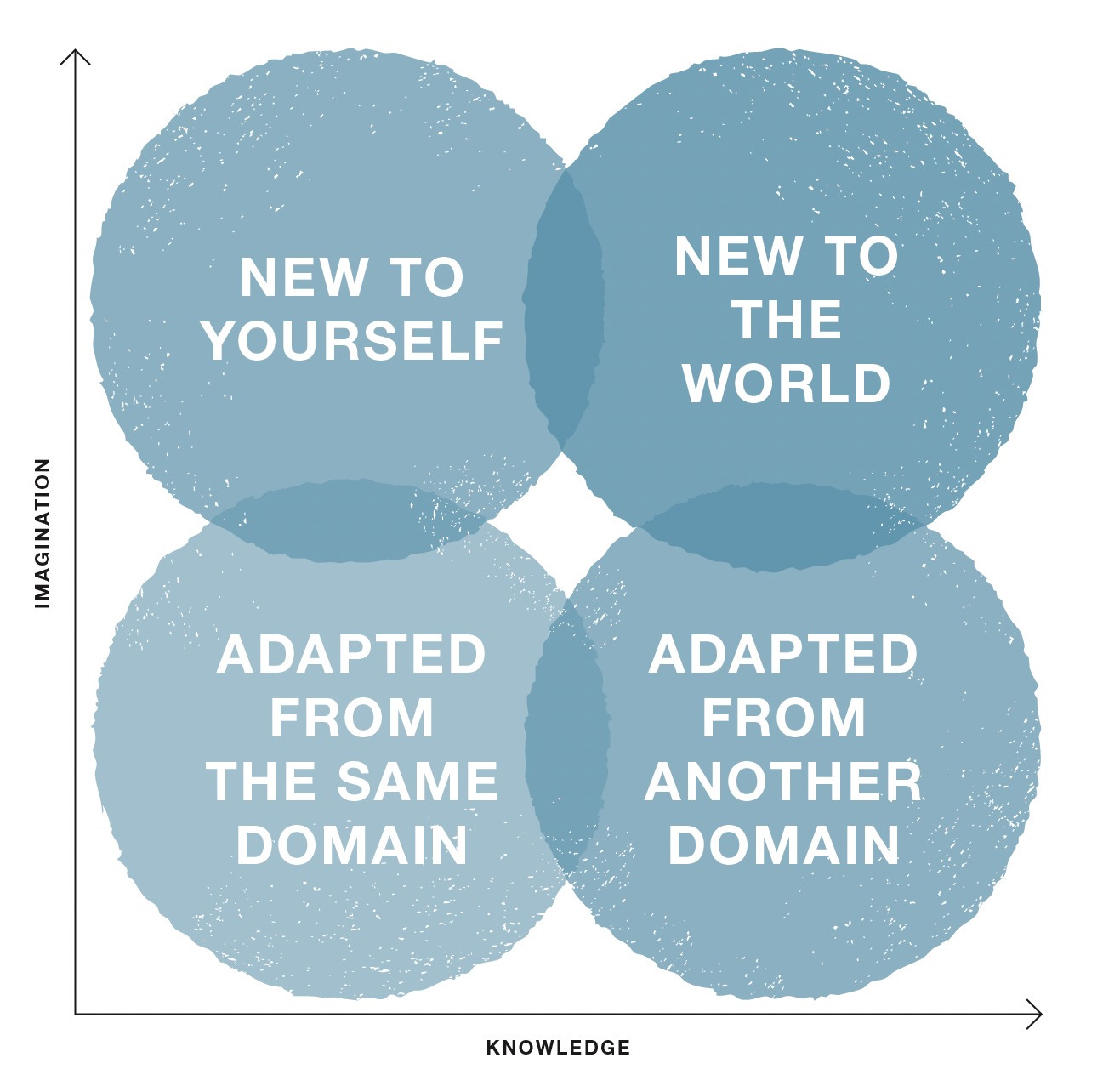
Originality doesn’t come from factual knowledge, nor does it come from the suppression of factual knowledge. Instead, it comes from the exposure of factual knowledge to the animating force of imagination. Depending on the quality of knowledge and the level of imagination applied to it, an idea can fall into four categories: 1) an idea adapted from the same domain; 2) an idea adapted from a different domain; 3) an idea that is new to the innovator; 4) an idea that is new to the world. These are listed in ascending order, with “new to the world” being the rarest and most valuable. The path of learning starts with the more modest forms of originality and leads to larger ones over time.
Imagination is a renewable resource. It doesn’t get depleted by use, but instead grows stronger with practice. When you learn the trick of dreaming, of disassociating your thoughts from the linear and the logical, you can become a wellspring of originality and brilliance. A client once asked architect Mark Kirkhart how he was able to produce so many fresh concepts for a single building. He said: “I have ideas I haven’t even had yet.”
Like all types of magic, dreaming is the result of practice. There are no shortcuts, only diversions and mental traps. In the following chapters I’ll let you in on the hidden discipline that allows innovators to produce their acrobatic leaps of imagination.
This is actually very well written - you seldom see this kind of clarity and insightful perspective. Creativity and insight are my main research interests, although I am more a practitioner than a scientist.
Marty, are you aware of Arthur Koestler's work?
Brilliant article Marty, loving the idea, we really need to hold on to our human traits and support the beauty of imaginative leaps. This phrase struck me particularly: "Imagination is a renewable resource. It doesn’t get depleted by use, but instead grows stronger with practice."