

The no-process process
METASKILLS Chapter 35

There’s a standard model that designers use to describe the creative process, usually with minor variations. Sometimes these are followed by a trademark notice, as if to say, “Hands off! This is my process, invented by me! By the way, did I mention it was mine?” Yet they all conform to the same progression that goes from a state of not knowing to a state of knowing, laid out in 4-10 logical steps.
The standard process looks something like this: 1) discovery, 2) definition, 3) design, 4) development, and 5) deployment. You could repeat some of these steps, or place them in a slightly different order, or add baby steps in between. You could also throw a step onto the front for getting the assignment, and another onto the back for launching the result. Most process diagrams are circular, suggesting that the end of the journey leads you right back to the beginning.
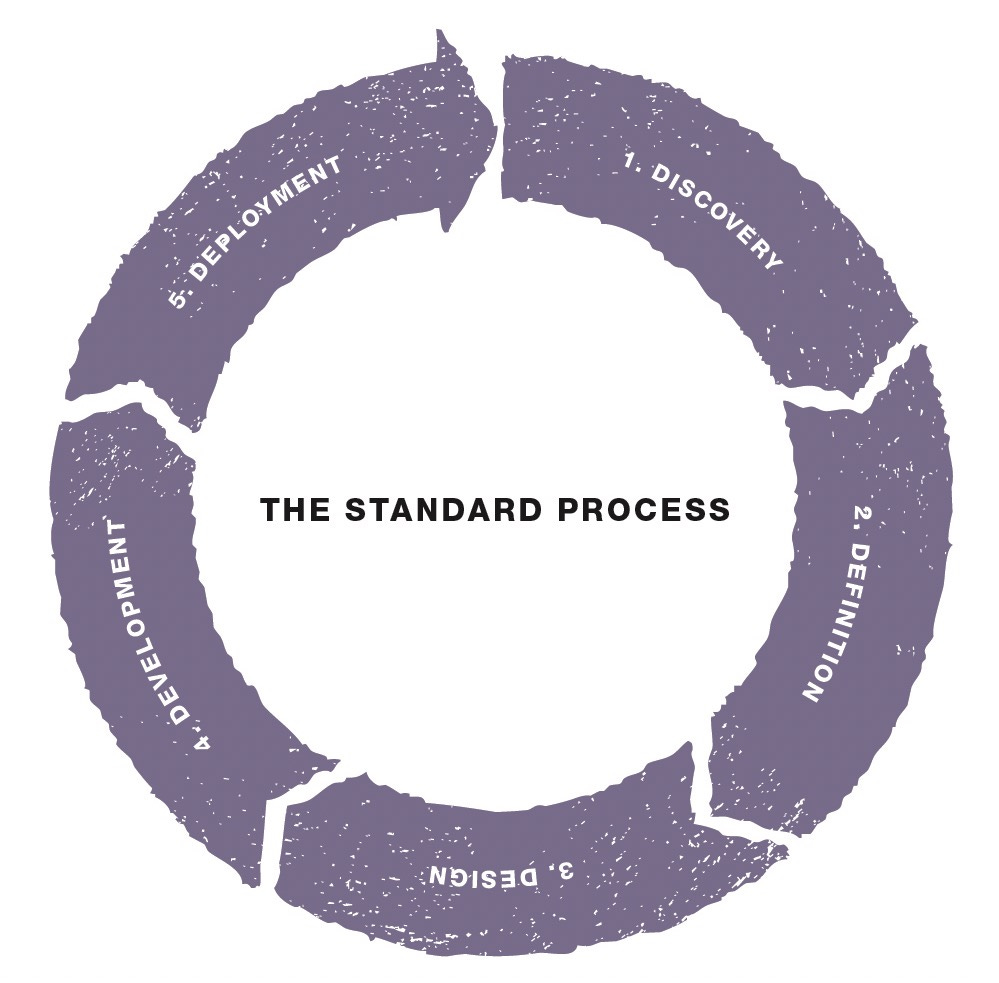
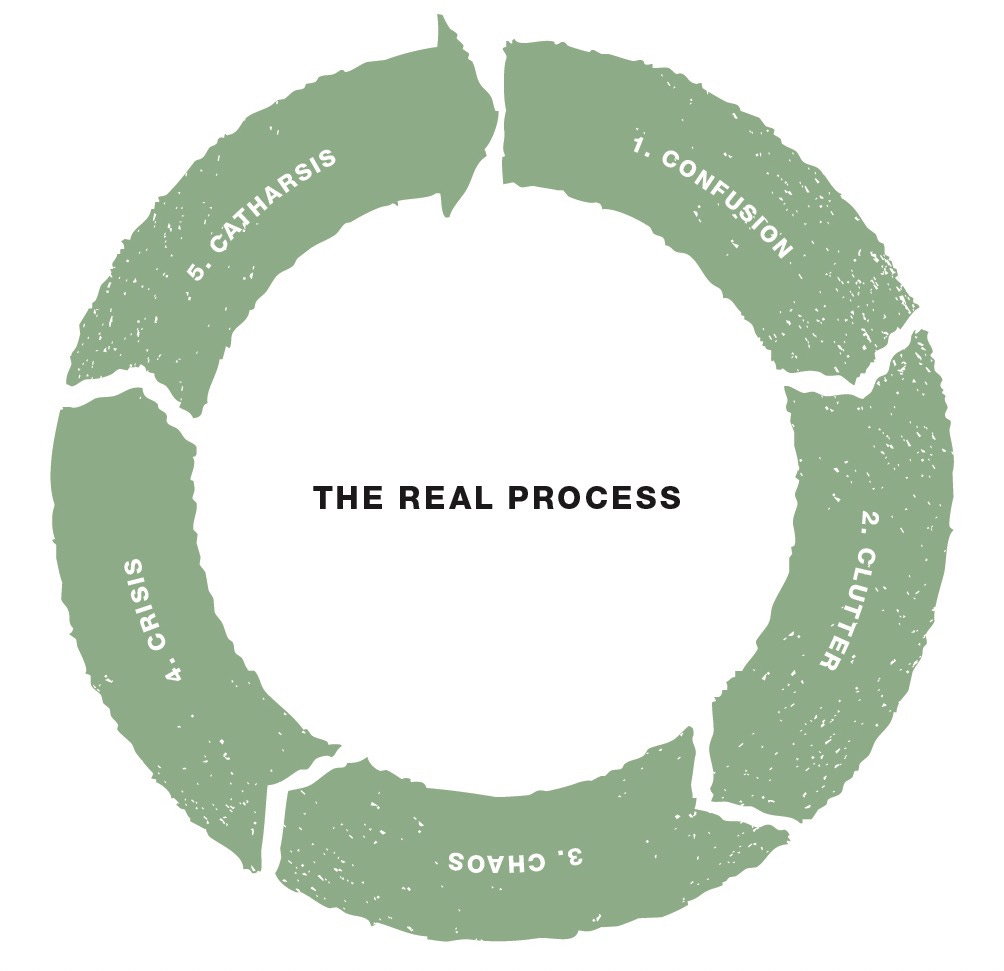
There’s only one hitch. A truly creative process bears little resemblance to these models. In theory there’s no difference between theory and practice. In practice there is. If it had to be circular, the real process of making things would look more like this: 1) confusion, 2) clutter, 3) chaos, 4) crisis, and 5) catharsis. But if designers presented this process as a diagram, they’d scare the bejeesus out of their bosses and clients. So instead they present the calm, confident progressions of the so-called “rational model.”
The rational model of design is not exactly wrong. It’s just not helpful. When used slavishly, it can lead to a significant waste of resources and a debilitating sense of hopelessness as originality and excitement turn to mediocrity and disappointment. Why would this happen? Because creativity doesn’t respond to project management so much as passion management. Creative passion is the primary resource, so it needs to be nurtured and guarded. Designers may taxi to the runway with briefings, data, and deadlines, but they reach flying altitude with emotion, empathy, and intuition. By overemphasizing process, you can discourage greatness.
A better model for designing is the no-process process, an approach that recognizes the chaotic nature of creativity. In the no-process model, you start with a general understanding of the problem, the goals, the areas of concern, the milestones, and the criteria for success. But the steps for addressing these areas should grow from the particular nature of the challenge, the circumstances in which the work will be done, the skills and workstyles of the team members, and the insights revealed as the project unfolds. It shouldn’t be forced to fit a diagram.
Listen to author Annie Dillard: “Rembrandt and Shakespeare, Bohr and Gauguin, possessed powerful hearts, not powerful wills. They loved the range of materials they used. The work’s possibilities excited them; the field’s complexities fired their imaginations. The caring suggested the tasks; the tasks suggested the schedules.” While few of us are Rembrandts or Shakespeares, the principle is the same. You chain creativity to a wheel at your peril.
But if there’s no process, where do you start? That’s easy. Anywhere. Everywhere. Whatever place releases the most energy. “It doesn’t matter where you start,” said composer John Cage, “as long as you start.” The important thing is that you cover all the bases by the time you’re done. By bouncing around from dreaming to research to model making to testing to walking to sketching to presenting to thinking to reading to arguing to sketching, you set off a chain reaction that a static process could never hope to match. The ideas virtually explode into being. The content determines the form, the form determines the content. Together they throw off clouds of surprising ideas.
The lifestyle stores known as Anthropologie have qualities of creativity and surprise baked into their business model. Each store has a large art room in the back where employees and contractors can experiment with new ways of displaying, merchandising, and creating products. As a result, no two stores are exactly alike, which allows them to keep their customers delightfully off-balance. The accepted notion that chain stores should aim for total consistency now seems hopelessly anachronistic.
As a believer in the magic of design, I have three fond wishes.
The first is that a greater number of creative people—designers, entrepreneurs, strategists, engineers, scientists—begin to embrace the true process of design, and abandon the comforting models that lead to mediocre outcomes.
The second is that educational institutions arrive at a similar understanding, making room for messy thinking and surprising ideas in the classroom. While I doubt I’ll see real paint splattered on the walls of Harvard, Oxford, and the Sorbonne, metaphorical splatters would be a start.
The third is that the leaders and managers of companies encourage the real process of design in all of its chaotic splendor, trusting, even insisting, that the results be more than efficient—that they be surprising, amazing, and occasionally even world changing.
I hear that from people in most countries around the world. Not so much in the UK, the US, and France, where people are more likely to voice their opinions and speak truth to power (at least a little).
Nice take. I think this is a classic case of having to know the rules first before you can break them. Never mind — one having to master the rules and process to a point where they play on behind the curtains as you get out of your own way to allow room for intuition - and less heady thinking - to do its thing.