

The play instinct
METASKILLS Chapter 30

How do you picture something that isn’t there? What’s the process for uncovering insights? Why do some people seem more inventive than others?
Hint: It’s not because they work diligently. Instead, it’s because they work differently. Imagination is the child of obstinacy and playfulness. It comes from a refusal to settle for the comfortable answer while having fun doing it.
During the Industrial Age, fun was discouraged. It took time to have fun, and time was the nonrenewable resource that needed to be managed, maximized, and measured. Employees were paid by the hour, the day, or the year. They were paid by number of pieces they could complete. Or they were paid by the predetermined function they performed. They were not paid by the number of new ideas they brought to the table or by the passion they brought to their work. Time was money and money was time.
After the clock came to Europe in 1307, it took less than a century for mechanical time to sweep the continent. With clocks you could agree on the delivery of a shipment, regularize the baking of bread, and estimate the completion of a brick wall. Clocks paved the way for sophisticated banking, transportation, mass production, and eventually computers. They brought precision to business. But they also brought an undue emphasis on quantity over quality.
The ancient Greeks understood that time came in two flavors: objective time, called chronos; and subjective time, called kairos. Chronos could be measured by the sun, the moon, or the seasons. Kairos could not be measured, only judged by the quality of one’s experience. My kairos is different from your kairos, but our chronos is the same. Today we use the phrase quality time to describe the experience of living in unmeasured time. We find that as soon as we measure or limit quality time, it quickly turns into quantity time.
Think back to a day in your childhood when you were so busy playing that you lost track of the clock. The minutes and hours blended seamlessly, one into the next, while your mind focused on some absorbing project or engaging activity. As you grew older, your play instinct began to fade. The requirements of society demanded more attention to objective time—an adherence to deadlines, agreements, and social courtesies—until play became more and more associated with nonproductivity, a kind of time that had no commercial value.
Yet quality time is the state in which imagination flourishes best. You can’t decide to produce an insight in 30 minutes or have an idea by 3:15. But you can decide to forget about the clock and focus on the challenge, in which case you may well have an idea by 3:15—or even five ideas. Imagination takes as long as it takes, and rushing it usually slows it down. This is the central conflict between the world of business and the world of creativity. They need each other, but can’t seem to understand each other. They’re working in two different kinds of time.
The solution to this dilemma, in my experience, is for business “doers” and creative “dreamers” to focus on goals instead of deadlines. Goals form the common ground that unites both workstyles. Focus on goals, take away the clocks, and start playing as soon as possible. What you’ll find is that generating ideas “out of time” can produce results much faster than holding yourself to a deadline. If you wait until the last minute, however, leaving little opportunity for play, you’ll find yourself clutching the first idea that floats by. Quantity time will enter the picture and force a mediocre result.
Goals are the common ground that unites business “doers” and creative “dreamers.”
If you could pry the roof off of all the mediocre companies in the world, you’d see an army of adrenaline addicts working on perpetual deadline, madly checking boxes instead of thinking ahead. You can get an immediate buzz from getting things done, but innovation requires something more—it requires unmeasured time in the dragon pit.
But what should you be doing there? What are the rules of creative play? How do you know when you’re winning? Here’s where quantity plays a crucial role. The best creative thinkers are usually the most prolific thinkers, because innovation, like evolution, depends on variety. In fact, you could say that innovation is really just evolution by design. The more ideas you have, the better your odds that two will combine to make a useful third idea. In the parlance of creative theory, you’re fluent. When ideas flow, the music of chance plays faster.
In London’s Highgate Cemetery, where ancient crypts lean out over twisted trails in silent competition for post-life prestige, one headstone stands in contrast. It’s a small gray rectangle lying flat against the edge of the road to mark the grave of historian Jacob Bronowski. Bronowski was the narrator of an early PBS series called The Ascent of Man. On screen he spoke slowly and with a little trouble pronouncing the letter R, his stage-glasses flashing into the camera whenever he delivered his most fascinating insights. “A genius,” he said, “is a person who has two great ideas.” What he meant was that innovation often comes from connecting two thoughts that previously had been unconnected. These might be two ideas that had never been considered together, or two ideas previously thought to be in conflict, or one old idea plus one new idea. Einstein’s term for this process was combinatory play.
While there may be nothing new under the sun, there’s no restriction on combining old things in new ways. For an exhibition called “Making Connections,” about midcentury designers Charles and Ray Eames, Ralph Caplan described their firm belief in combinatory play—the excitement of connecting disparate materials such as wood and steel, of connecting alien disciplines such as physics and painting, of connecting people like architects and mathematicians or poets and corporate executives. The connection point “is the crack in the wall, the point at which a designer can sneak past the limitations while no one is looking.”
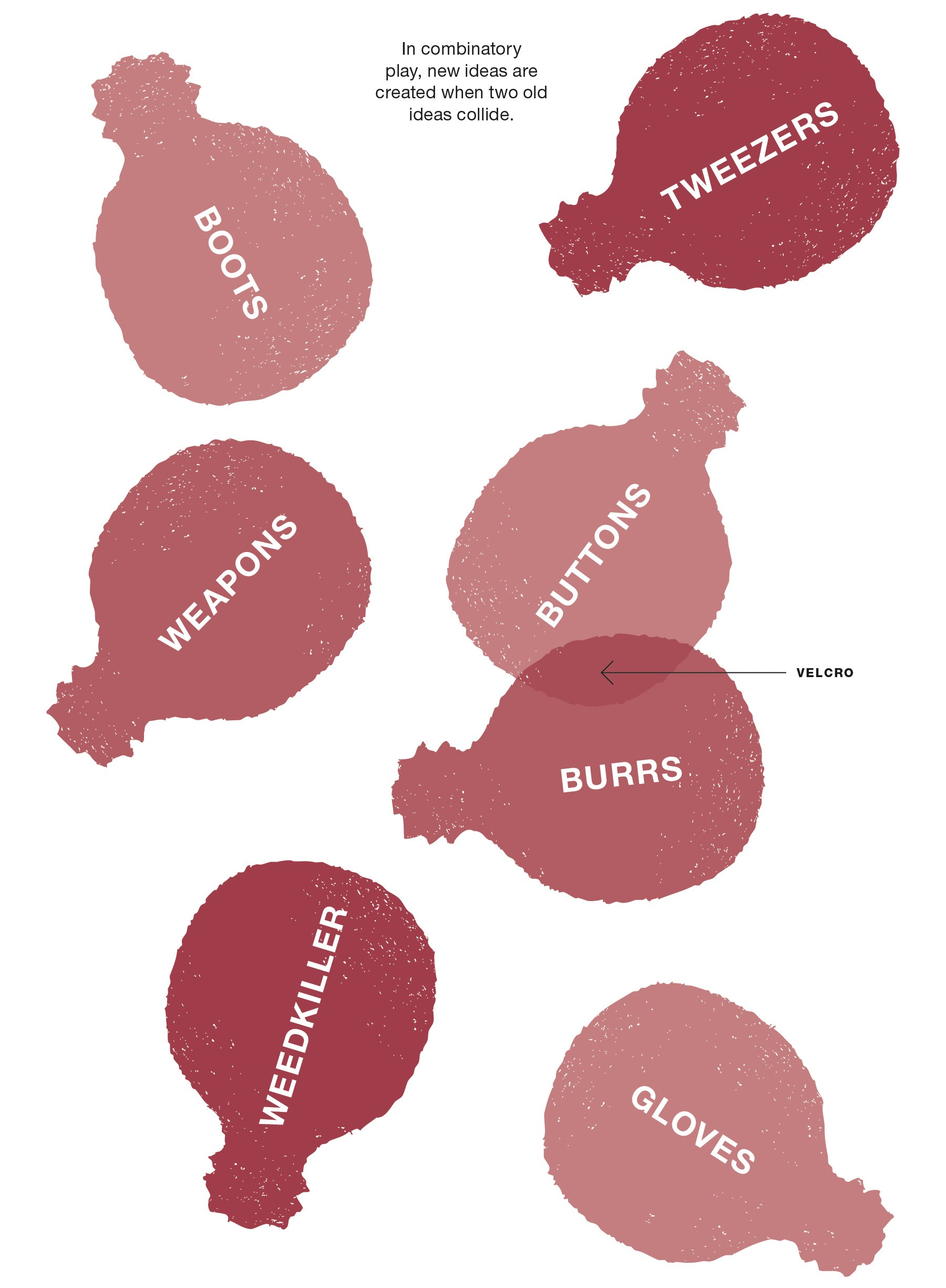
The importance of connections is also echoed by recent discoveries in neuroscience. The brain forms new ideas when two old ideas suddenly overlap. Cortical cells then make new connections, rewiring themselves into fresh networks. Once the insight has been formed, the prefrontal cortex can name it and claim it. But the real genius lies not in making interesting combinations, but in separating the great ideas from the merely crazy ones by applying the principles of aesthetics. Some connections offer a better fit than others.
Of course, it’s easy to talk about fluency and variety and prolific imagination, but how do you start? What’s the selection criteria? Where do combinable ideas come from?
Happily, they come from learnable techniques. While some people may be naturals in the realm of imagination, we can all improve our skills with deliberate practice. Here are ten strategies that can trigger new ideas.
Think in metaphors. A metaphor is a way of making a comparison between two unrelated things. “All the world is a stage” is an example. The world is not a stage, but it’s like a stage in some ways. Shakespeare could have used a simile instead of a metaphor—“The world is like a stage”—and it would have had the same meaning, just not the same impact. By saying the world is a stage, a fresh idea is forced to emerge—that every person is merely playing a part.
Thinking about problems metaphorically moves your thinking from the literal to the abstract, so you can move freely on a different plane. To a literal thinker, a rose is a rose. To a metaphorical thinker, a rose could be a young woman’s cheek, a seductive trap, or the morning sky before a storm. If your challenge is to invent a new name for a store that sells footwear to active girls, you could call it Active Footwear. Or you could think in metaphors and move beyond the first pasture. For example, maybe active footwear for girls is like the ballet slippers in The Red Shoes, or like a bouncy pop song from the sixties, or like—wait a minute. What if we call it Shubop?
Think in pictures. Many people assume Einstein was a logical, left-brain thinker, but he was actually the opposite. Rather than using mathematics or language to crack a tough problem, he preferred to think in pictures and spatial relationships. This is because visual thinking can strip a problem down to its essence, leading to profoundly simple conclusions that ordinary language might not be able to reach.
Visual thinking isn’t just for graphic designers, artists, and illustrators. It’s for anyone who can draw a stick figure, an arrow, and a talk balloon. Pick up a copy of The Back of the Napkin by Dan Roam to learn a few of the most useful tricks. You’ll wonder why more people don’t think like Einstein.
The best creative thinkers are usually the most prolific thinkers, since innovation, like evolution, depends of variety.
Start from a different place. Your brain builds up patterns of experience that act as attractor states, making it hard to think in new ways. Your best shot at clearing this hurdle is not to try and jump it but to go around it. Start from a different place. Start from a place that doesn’t make any sense. Better yet, think of the worst place you could possibly start, and start there.
Let’s say, for example, your task is to negotiate a peace treaty between warring states. (What? You don’t have that on your calendar?) So far no amount of reasoning has been able to bring the two sides together. You could try more reasoning, or better reasoning, or perhaps the threat of draconian intervention, but these are likely to cause further entrenchment.
So you start from a different place. What would be the worst way to structure the talks? How about suggesting that the two leaders declare immediate, mutual, all-out war? Obviously, that’s crazy. But at least it’s different. Okay, what if you suggest it anyway, just to make a point about the absurdity of war? Then, when the two parties reject the idea, you can propose a less dramatic solution: Arm wrestling to the death, winner take all. No? How about this? Arm wrestling, and whoever loses buys the other a beer. Now we’re getting somewhere. At least they’d have to be human, which would count as progress and make a great photo op as well.
The arm-wrestling photo op solution may not be the final idea, but you can see how difficult it would be to get there using the standard negotiating handbook. Next you might imagine other photo ops that could serve as clever backdrops for negotiation, and so on and so forth. By following the trail from the worst idea to a workable idea, you can avoid being imprisoned by old patterns.
Poach from other domains. Voltaire said, “originality is nothing but judicious imitation.” What could be more judicious than stealing ideas from other fields? While stealing is not the same as pure imagination, it still takes a mental leap to see how an idea from one industry or discipline might be used in another industry or discipline.
Gutenberg got the idea for the printing press from watching the mechanics of a wine press. This mental connection launched the book industry, and did no harm to winemakers.
One fine summer day in 1948, amateur inventor George de Mestral took his dog for a walk in the woods. Upon returning, he found his dog and his pant legs covered in pesky burrs. When he put them under a microscope he saw tiny hooks, perfectly suited for attaching themselves to fur and fabric. The result? Velcro.
In 1921, a 14-year-old Philo Farnsworth got the idea for the electronic television while tilling the family’s potato farm. The back-and-forth plowing pattern suggested the back-and-forth scanning pattern for cathode ray tubes. Talk about stealing ideas from another field!
Arrange blind dates. The cases above show how a prepared mind can make novel connections under the right circumstances. But it’s also possible to force connections by introducing two unrelated ideas. What do you get when you cross a bank with an Internet café? A shoe store with a charity? A Broadway show with a circus performance? Adhesive tape with a bookmark? You get successful business models like ING Direct, Tom’s Shoes, Cirque du Soleil, and Post-it Notes.
Of course, you can also get the business equivalent of kitsch, as Clairol did when it crossed yogurt with hair care and got Touch of Yogurt Shampoo. Or as Omni did when it crossed a television hit with a carbonated drink and got Tru Blood soda. Don’t fall in love with your first idea. Novelty and innovation are two different things.
Reverse the polarity. While it doesn’t usually work with electronics, reversing the polarity in an assumption can release conceptual energy. Here’s how you do it:
Let’s say your challenge is to get your employees to wash their dishes instead of leaving them in the sink for someone else to do. You can start by listing some assumptions about the problem.
1. Employees don’t like doing dishes.
2. It’s hard to tell whose dishes are in the sink.
3. The dishes are company property.
4. Dishes are easier to clean after they soak.
5. Dishes tend to pile up.
Now, reverse the assumptions to see what happens.
1. Employees love doing dishes.
2. It’s easy to tell whose dishes are in the sink.
3. The dishes are employee property.
4. Dishes are easier to clean before they soak.
5. Dishes never pile up.
What would it take to make these true? Well, employees might love doing their dishes if they had a great music system at the sink. It would be easy to tell whose dishes were in there if each item were personalized with the employees’ names or initials. Maybe employees could be allowed full kitchen privileges, but only if they agreed to use their own kitchenware. Or maybe you could install a large-capacity dishwasher that makes it just as easy to put dishes there as in the sink. Or maybe you could make your sink and sideboard so small that the dishwasher was the only logical place to put them. Of course, you could just lay down the law, then enforce it with a surveillance camera. But that seems a bit draconian.
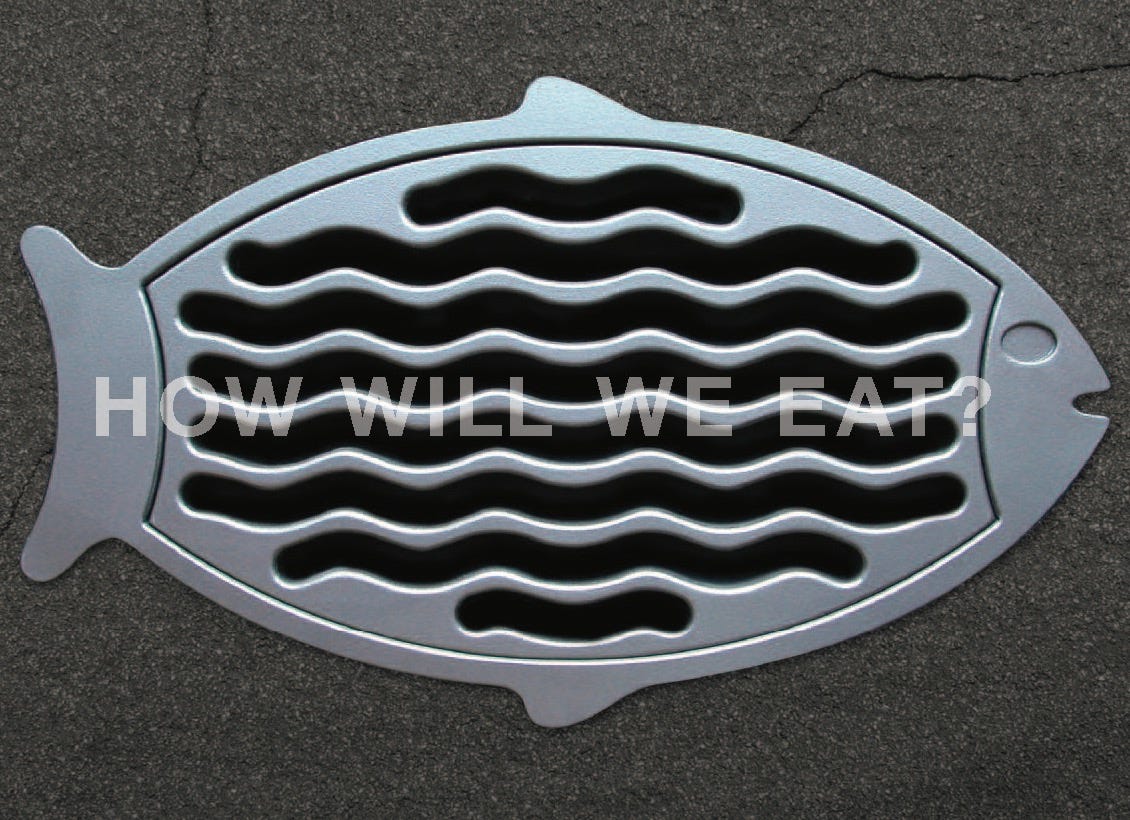
Find the paradox. If you can describe the central contradiction within a given problem, you’re well on the way to solving it. When designer Mitchell Mauk noticed a problem with the storm drains in San Francisco, he took it the initiative to propose a solution. The city had been concerned about people dumping motor oils and chemicals into the sewers, where they would flow into the bay and pollute the fish habitats. The usual warnings posted near the drains weren’t working.
The central contradiction might have been stated like this: People won’t stop dumping toxins through the sewer grates unless they can read the signs, and they won’t read the signs if they’re too busy dumping toxins through the sewer grates. So Mauk asked the question another way. Can the sewer grates and the signs be one and the same? His elegant Gratefish sends an unambiguous message: Whatever you put down the drain goes right into the fish.
Give it the third degree. What else is like this, from which you could get an idea? Is there something similar that you could partially copy? What if this were somewhat changed? What can you eliminate? What can you substitute? Is this the cause or the effect? What if you changed the timing? In whose shoes should you put yourself? The questions are endless, but they don’t take much time to ask.
Be alert for accidents. The great thing about creative play is that mistakes don’t have consequences. You’re free to follow any rabbit down any hole. While most of the time you won’t find what you’re looking for, sometimes you’ll find what you weren’t looking for, and that can be even better.
When mechanic John Hyatt was looking for a substitute for billiard-ball ivory, he accidentally invented celluloid, the plastic used in making movie film and hundreds of other products.
When Percy Spencer was working on radar for the military, he found a melted candy bar in his pocket, thus discovering the working principle for microwave ovens.
Steve Jobs, while trying to design a tablet computer, discovered a great set of features for the iPhone instead. The iPhone became the stepping stone back to the iPad.
Physicist Richard Feynman had a simple test for new ideas. “What did you discover that you didn’t set out to discover?” If you only found what you expected to find, your idea probably isn’t new.
Write things down. When I was a wannabe songwriter in my teens (who wasn’t?), I never worried that I might forget a line of melody or snippet of lyric. I told myself if it were that good it would probably come back to me. Conversely, I believed if it didn’t come back to me, it probably wasn’t that good. There were two flaws in this logic. First, I did forget good musical ideas, and, second, the value of ideas often lies in their ability to trigger better ideas. If you don’t capture them, you can’t build on them.
When ideas flow, the music of chance plays faster.
“Ideas never stand alone,” says Kevin Kelly. “They come woven in a web of auxiliary ideas, consequential notions, supporting concepts, foundational assumptions, side effects, logical consequences, and a cascade of subsequent possibilities. Ideas fly in flocks,” he says. “To hold one idea in mind means to hold a cloud of them.”
A cloud of ideas is a wonderful image. But my advice? Don’t try to hold them all in your mind. Write them down. Record them. Get in the habit of taking notes, keeping a diary, carrying a sketchbook, or thinking out loud on a whiteboard. Just because play is fun doesn’t mean your ideas aren’t worth saving. This is especially true when the playground is collaborative.