

There be dragons!
METASKILLS Chapter 28

The frame of a problem is not a comfortable place. It’s filled with tension, confusion, danger, and doubt. It’s a veritable dragon pit of unresolved conflict. On one side you’ve got the reality of what is, or what is common, and on the other side you’ve got a vision for what could be, or what could be different. In between lies a battle. For this reason most people are eager to get in, make a decision, and get out. But creative people know they have to stay in the dragon pit because that’s where the ideas are.
The uncomfortable tension between what is and what could be creates a mental spark gap—a space between two poles that can only be bridged by a leap of imagination. If you close the gap too quickly by making the easy decision, there’s no spark. If you keep it open longer, ideas and insights will start to appear in rapid succession.
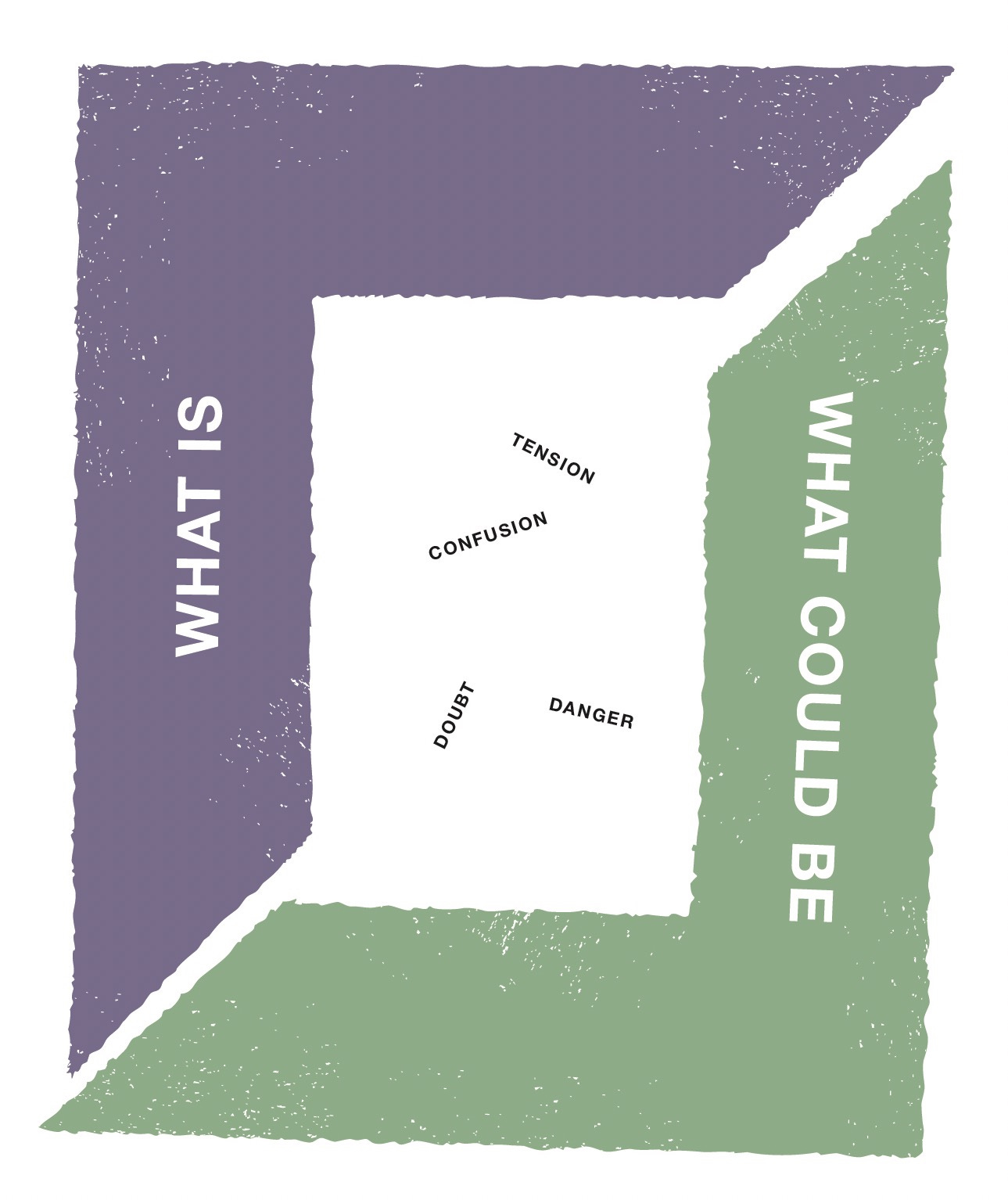
Pretend you’re a commercial farmer growing tomatoes for a living. On one side you feel competitive pressure to use more pesticides and chemical fertilizers to increase yields and control costs. On the other side you face mounting criticism from environmental groups and customers who are calling for organic farming methods. The quickest fix is to decide one way or the other—either go large and commercial or small and organic. However, neither is a very good solution. The demand for low prices will continue, and the desire for organic produce will keep growing. By staying in the pit it’s possible to imagine a third alternative that exists outside this simple dichotomy.
How, you ask? By learning to embrace paradox. A paradox is a proposition that contains two contradictory thoughts while expressing a truth. For example, Thoreau’s statement that “the swiftest traveler is he that goes afoot” would seem to be a contradiction. Everyone knows that walking is not the fastest mode of travel, but the paradox contains an idea: You might make more progress by keeping things simple. Or you might learn faster by doing things the hard way. By expressing a problem as a paradox, you force your mind to look for new answers.
The uncomfortable tension between what is and what could be creates a mental spark gap.
Physicist Niels Bohr found that by holding two opposing thoughts in his mind at the same time he was able to move his imagination to a higher level. In some cases, like the problem of understanding electrons, the paradox he met with was actually the answer. Complementarity, now a basic principle of quantum theory, proves that an electron can be both a wave and a particle at the same time, even though it can’t be viewed both ways at once. While it confounds our sense of reality, it’s true nevertheless.
One of the qualities of a genius is a strong tolerance for ambiguity. This is often difficult, because the human brain seeks closure. We’re uncomfortable with the feeling of cognitive dissonance, of not knowing the right answer. And a brain that doesn’t like paradox is one that jumps to any conclusion, right or wrong, that can end the debate. The secret to getting the most out of your imagination is to keep the problem in a liquid state as long as possible.
The scientific tool of hypothesis, defined as a testable supposition, is less science than art. It’s more akin to the maquette of the sculptor or the preliminary sketch of the painter than the provable truths we associate with the scientist. The painter has to be willing to draw badly or paint uncertainly while working through a new composition. “Art needs to incubate, to sprawl a little, to be ungainly and misshapen before it finally emerges as itself,” says Julia Cameron, author of The Artist’s Way. “The ego hates this fact. It wants instant gratification and the addictive hit of an acknowledged win.” Creative thinking, whether in the service of art or science, requires that we postpone gratification while we try out different approaches.
New ideas can’t be proved in advance. This comes close to being a tautology, as if saying, “New ideas are new.” Yet the ways we’re taught to use logic don’t account for this simple fact. We’re taught to reason using only deduction and induction, two methods handed down from the Greeks that make little use of imagination. Deduction is the logic of argument, drawing specific conclusions from general rules. Induction is the logic of educated guesses, drawing general conclusions from specific observations. While both of these are helpful in judging a hypothesis, neither is suitable for creating a hypothesis. For this we need a third kind of thinking called abduction, the nonlogic of what could be.
If architect Frank Gehry had used logical reasoning as a starting place for his projects, he never could have invented the swooping, shimmering forms of Bilbao’s Guggenheim Museum. He would have designed a very nice building that the city could be proud of, but that few tourists would consider a destination. To escape the trap of logic, he started by drawing shapes that made use of his imagination, emotion, and gestural instincts. Undoubtedly, many of these were “ungainly and misshapen,” but something mysterious and satisfying began to emerge, a highly sculptural edifice with the curving forms of a sailing ship. He called this stage “capturing the dream.” It’s not the result of logic but of nonlinear thinking, a conscious choice to avoid the deeply rutted road.
The search for innovation is progressive, starting with the most obvious ideas and moving further out with each attempt. First ideas are rarely the best ideas, and real innovators recognize this. They force themselves to climb onward and upward until they arrive in virgin territory. In some creative circles, this is known as “third-pasture thinking.” When horses are let into a pasture, most will be content to eat the grass they find there, even though it’s been trampled by previous herds. Some horses, however, will move up into a higher pasture where the grass is slightly fresher. One or two others will climb all the way to the third pasture, where the grass is pristine and new.
The New Yorker hosts a popular contest in which readers are invited to fill in the caption for a new cartoon. Tellingly, the editors found that about 20 percent of contestants would come up with the same funny line for the cartoon. Very few would make the leap to a surprising and concisely written caption that rose beyond the simply logical. Those 20 percent got stuck in the second pasture. They probably never realized there were fresher ideas further up the hill.
The proper approach to invention is not logic but wonderment. Creative thinking begins with phrases like “I wonder,” “I wish,” and “what if.” It sets out from a position of not knowing, then winds slowly and circuitously through the problem until it finds something unexpected and untried. It then takes that something—the so-called “germ of an idea”—and begins to poke and pull and twist it until it resembles something new. It only attains the status of knowledge when it’s been tested in the real world. How does it get to the real world? Through the dogged persistence of a dragon slayer.