

Thinking whole thoughts
METASKILLS Chapter 19

Drawing a picture in a visually realistic way is not really a drawing problem. It’s a seeing problem. Until we can clearly see what’s in front of us, free of misleading beliefs and partial knowledge, our picture will necessarily be distorted or fragmented. Painter Robert Irwin said, “Seeing is forgetting the name of the thing seen.” As soon as we label something, we put it in a box and move it to another part of our brain. We stop seeing it as it really is.
Seeing and thinking are related concepts. We claim to see what people mean; we look for answers; we envision a solution; we follow a line of thought; we draw conclusions; and with any luck we connect the dots. In trying to make these connections, we’re searching for patterns that show us how objects and events are linked, or need to be linked, in order to make sense. We’re looking for the emergence of a complete picture.
Leonardo da Vinci epitomized this relationship between seeing and thinking, as amply illustrated in his notes. His scientific insights came straight from his passion for drawing; he drew things to understand them. He was fascinated by the repeating patterns of nature, intensely curious about the fundamental experience of being human in the natural world. He made hundreds of drawings of the human eye, of whirlpools in streams, of sound moving through the air, of the similarities and differences among people, plants, and animals. He was trying to see how things are connected, and the way nature continually transforms itself. He was searching for a unified vision of the world.
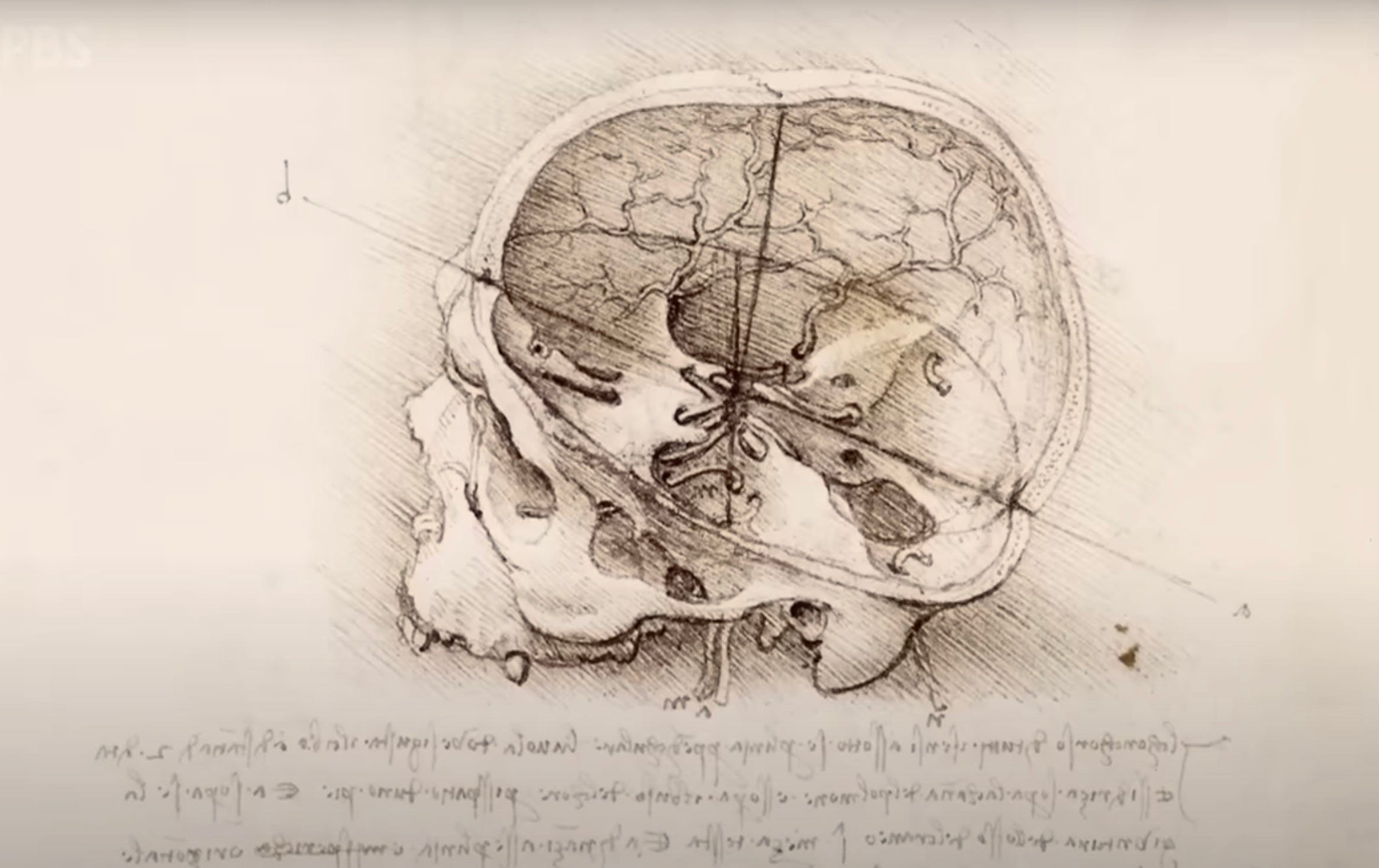
We might well call Leonardo the father of holistic invention. His approach to art and science, and to feeling and thinking, was both simultaneous and seamless. The ideal of the Renaissance Man doesn’t suggest that we learn everything about everything, but that we see the world as an interconnected system of systems, instead of separate parts.
On a good day, this is exactly what designers do. They observe a situation—a product, service, experience, process, a communication, or business model—then devise new components, new relationships, new interactions that reshape the situation into something better. Their metaskill of visualization—of seeing how to see—makes this transformation possible.
Since the peephole of consciousness is so small, most people find it easier to focus on a single tree than a whole forest. But if our goal is to reshape a situation, we need to see the trees, the forest, and the relationships among them. We’ve been playing checkers when we really need to play three-dimensional chess. As design thinker John Thackara says, we need to employ macroscopes as well as microscopes. We need to understand how the parts interact if we want to improve the larger situation. The whole is not the sum of the parts, and merely improving the parts can court unwelcome surprises.
As a young designer, I used to wonder about the common remark, “I’m no artist—I can’t even draw a straight line.” A straight line had always seemed to me evidence of noncreativity, the refuge of the logical, the prosaic, the unartistic. Why would anyone think drawing a straight line was an important skill? We have T-squares for that! Someone finally took me aside and said, “It’s just an expression.” Oh.
Yet straight-line thinking has co-opted Western thought to the point that we have trouble understanding cause and effect. We forget that the world isn’t linear. It’s full of arcs and loops and spirals. It often seems more like a Rube Goldberg contraption than Newtonian equation. We can pull a lever here and get an unintended consequence over there.
For example, today the developed world is fighting recession. Should we balance the books with a massive austerity program? Or grease the wheels with a series of stimulus packages? Both “solutions” might seem logical, but either one could bring the roof down on our heads. Complex problems are embedded in complex systems, making them impossible to solve using linear thinking. We send aid to foreign countries to fight poverty, only to find we’re feeding corruption instead. We formulate new drugs for viruses, only to find that the viruses mutate into stronger ones. We develop pollution-free nuclear energy, only to end up with a nuclear waste problem that could haunt us for ten thousand years.
With complex problems, things are not always what they seem. Trying to turn a nonlinear world into a linear world for our emotional comfort is usually a bad idea, because linear planning only works with problems that can’t resist our plans. People, viruses, and atomic particles don’t conform to linearity—they have a way of fighting back. They seem to mock our naïve attempts to analyze them. As science-fiction writer Poul Anderson once said, “I have yet to see any problem, however complicated, which, when looked at in the right way, did not become still more complicated.”
The Industrial Revolution has been a triumph in reductionist thinking. By focusing on narrow problems, we’ve learned how to move large weights over long distances, increase our production of food, eradicate a whole raft of diseases, transport people through the air, communicate instantly around the world, and perform any number of miraculous feats. Yet to the extent we’ve been thinking in fragments instead of whole thoughts, our solutions have only created bigger problems that are now beyond our comprehension. We now have to grapple with pollution, obesity, overpopulation, terrorism, climate change, and recession, to name just of few of our ailments.
We forgot that the world isn’t linear. It’s full of arcs and loops and spirals. Linear planning only works with problems that can’t resist our plans.
The only way to address these so-called wicked problems—slippery conundrums that disappear around the corner when you try to follow them—is to heed the advice of philosopher Ludwig Wittgenstein. “Don’t get involved in partial problems,” he said. “Always take flight to where there is a free view over the whole single great problem, even if this view is not a clear one.” In other words, think in whole thoughts instead of fragments. Step back from the drawing board and notice the relationships among the lines, the edges, the angles, and the shapes. Check them against reality, one by one and all together.
This mode of seeing is variously known as systems thinking, adaptive thinking, cybernetics, and holistic thinking. Wicked problems don’t easily yield to hard analysis, linear logic, or propositional knowledge. They’re more likely to give up their secrets to observation, intuition, and imagination. Like an artist composing a canvas, a systems thinker squints at a problem to see the complete picture instead of the components.
The chapter reminds me of working in healthcare - specifically R&D for new approaches to treat patients. One question we reminded ourselves of over and over again: "What are we solving for?" It was meant to keep us aware that 'solving' for a patient's symptoms often overlooks the underlying disease.
Strategy seems to bear a resemblance. It's vital that the strategist (nobody on the management team is generally very good at this) is solving for the cause, not the symptoms.